Adult Acne & Root Causes: What Lab Testing Could Reveal About Underlying Imbalances
A Holistic, Lab-Based Approach to Understanding Adult Acne from a Naturopathic Perspective
This is something I hear often: Someone feeling frustrated about their adult acne after trying different skincare products, topicals, and routines, only to find that their skin hasn’t budged, or that they’re back at square one.
It’s common for many to approach acne as a skin-level problem, and understandably so. And topicals and routines are often the first place people turn to. But after nearly a decade of working with patients, and after going through my own acne journey, I’ve come to appreciate that acne, at different stages of life, could reflect more than what’s happening on the surface.
In this post, I share how I approach lab work as one tool for exploring the underlying factors that may be contributing to adult acne from my perspective as a licensed naturopathic doctor.
Disclaimer: The information in this post does not constitute medical advice; is not meant to diagnose, prevent, treat, or cure any conditions or disease; and is meant for educational and informational purposes only. Nothing in this post creates a doctor-patient relationship. Your use of the information provided here is at your own risk. Statements regarding supplements have not been evaluated by the U.S. Food and Drug Administration. The information in this post does not replace or substitute the advice of your medical provider. Speak to your doctor before starting any new treatments or supplements.
Where I Start: A Comprehensive Intake
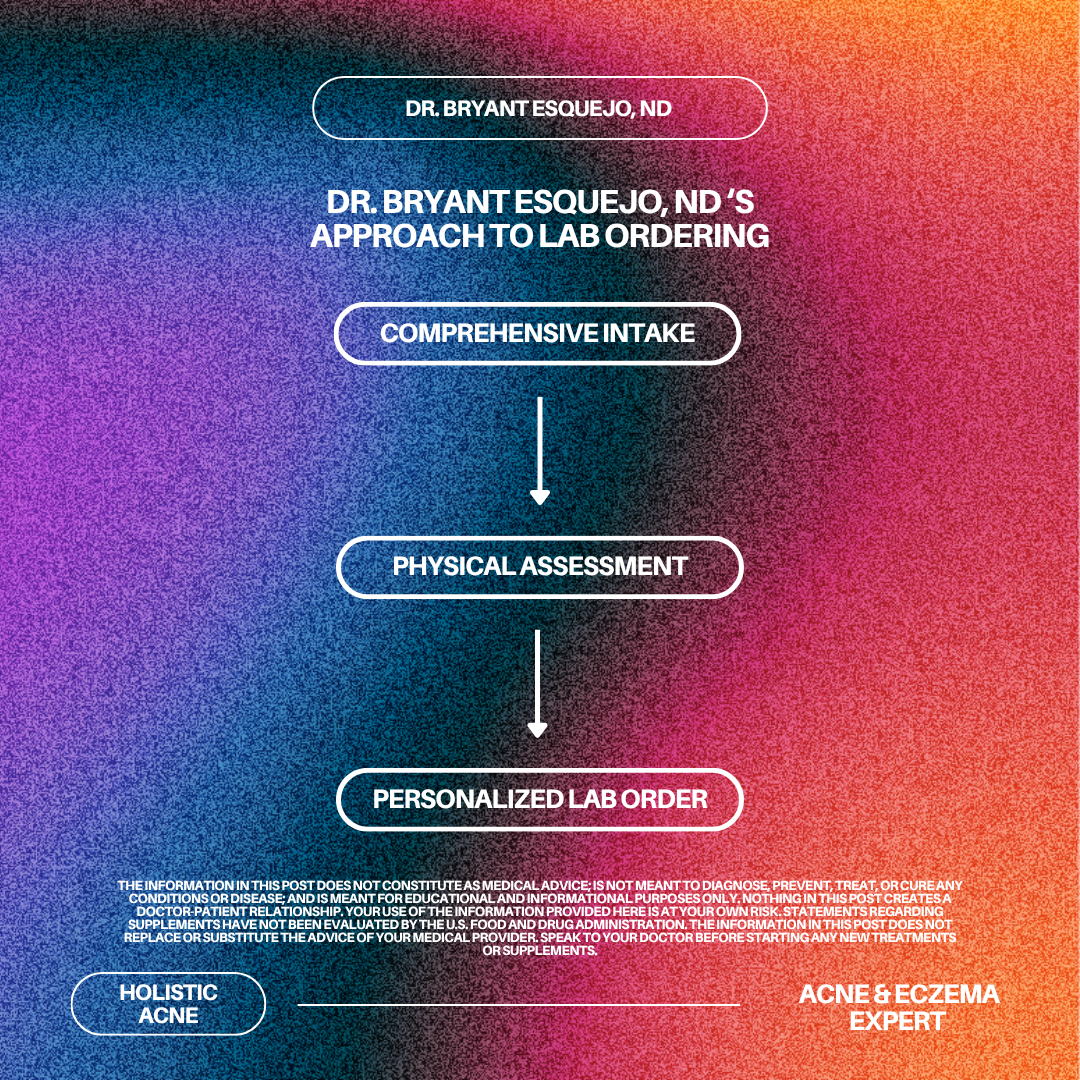
When someone comes to see me about their adult acne, I don’t begin the conversation with labs. I start with a comprehensive intake.
At that first visit, I often explain that I’d like to understand their acne from a holistic perspective, exploring what’s visible on the skin-level, while also looking at the internal factors that may be influencing what they’re seeing on the surface.
To build that skin-level understanding, I ask questions like:
How long has this been happening?
What have they tried in the past, and how did their skin respond?
Do they notice any patterns with their skin?
What does their current skincare routine look like?
And much more.
From there, I also explore internal physiological systems that scientists have associated with acne, including: Hormones, blood sugar regulation, gut function and digestion, hypothalamic-pituitary-adrenal (HPA) axis stress physiology, and nutrient status, among others.
After gathering that information, I move on to physical assessment.
When someone sees me for acne, I’ll typically assess their skin directly. Depending on what they’ve shared about their symptoms and patterns, I may also complete additional assessments to get a broader baseline understanding of other organ systems.
For example, if someone mentions gut symptoms alongside their acne, I’ll speak with them about completing an abdominal assessment as well.
It’s from this intake and physical assessment process that I begin to form a clearer sense of what might be contributing to someone’s acne process… and where lab work could offer additional insight.
Personalized + Individualized Lab Orders
One of my goals when I work with my patients is to help them better understand their skin, internal health, and biology.
Lab work could be one piece of that deeper understanding, and could be a way to begin uncovering patterns or imbalances that might not have been on someone’s radar before.
When I start thinking about what labs could be worth exploring, I first map out the underlying factors I suspect could be contributing to someone’s acne process based on what I’ve learned from their intake and physical assessment.
From there, I’ll have a conversation with my patient about specific biomarkers, lab tests, and lab panels that could help shed light on those suspected drivers or reveal other factors that haven’t come up yet.
In those conversations, I often highlight the value of lab orders that feel both foundational and comprehensive given someone’s unique health picture.
If my patient indicated that they haven’t had any labs done in the past year, I’ll talk with them about the importance of getting that baseline established first to make sure that we’re not missing anything significant before digging deeper.
Beyond the foundation, I may also discuss tests and panels that could help zero-in on what’s specific to their acne process.
For example, if someone’s symptoms and patterns suggest there could be a hormonal component, I’ll talk with them about the science connecting hormones to acne, and what biomarkers could offer a clearer view of their individual hormone physiology. Or, if they’ve mentioned gut symptoms alongside their acne, we might explore what lab options exist to look at that connection more closely.
Ultimately, lab orders can look different from person to person. That said, one question comes up often when patients are eager for answers: Is having more lab data always better?
Is Getting More Labs Always Better?
Lab data, to me, is most valuable when it helps build a more-complete picture of someone’s health. But, more data doesn’t automatically mean more clarity.
A lot of people I see are eager to get as many lab tests, panels, and biomarkers as possible. And I understand where they’re coming from. They’ve been frustrated with their adult acne for a long time and want answers. It’s also common for people to come in with specific ideas about what they’d like to get tested.
What I often find myself sharing is that more labs don’t always translate to a clearer path forward. While I do think that it’s important to get the warranted and relevant labs done, both to establish baseline health and to explore suspected drivers, there are situations where additional data could start adding noise rather than being useful.
In my experience, information is most useful when it’s meaningful, when it can actually change a decision or illuminate an actionable path. Labs that fall outside the context of someone’s intake and physical assessment may raise more questions than they answer, and can sometimes make the journey feel more overwhelming rather than more clear.
That’s why being intentional and methodical about lab work matters to me. Having a method, like a thorough intake followed by physical assessment, provides the context that helps make lab data meaningful. It’s also what helps ensure that any labs ordered connect to something specific about a person’s unique health picture. So that what comes back actually informs next steps rather than adding more to sort through.
Starting With Curiosity
Adult acne can feel like an isolating and frustrating journey, especially when it feels like you’ve already tried so many things. I know that feeling, and it’s something I’ve heard often in the clinic room.
What I’ve come to appreciate, both through my own skin journey and through working with patients over the years, is that the skin is often reflecting something deeper, like something happening within the body’s internal physiology.
Lab work, when approached thoughtfully and within the right context, can be one meaningful piece of that larger conversation. It’s not about chasing a single answer or finding a quick fix. It’s about building a clearer picture of what’s happening beneath the surface, so that any next steps feel grounded and intentional.
If you’ve been feeling frustrated with your adult acne, like feeling you’ve been doing everything right and still not getting answers or relief, there may be more to your story. A perspective that intentionally explores skin from the inside-out could help uncover patterns that aren’t always obvious at the surface.
If this resonates and you’re starting to think about your skin in a more personalized way, you can book a consultation below.
Want to learn more about skin health from a holistic & integrative point-of-view? Read my articles on:
Check out my latest press features:
Follow me on social media: Instagram, TikTok, and Threads.